
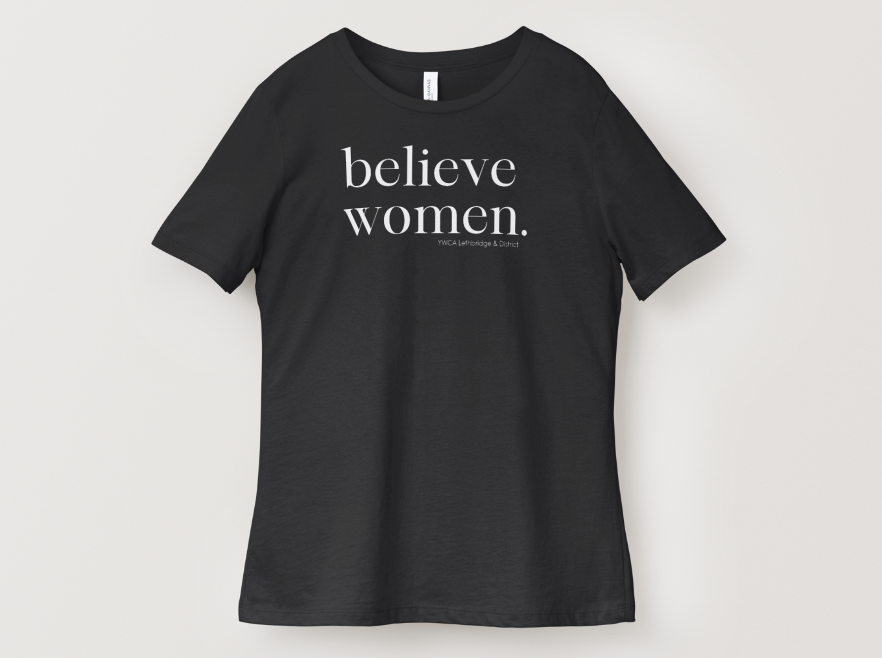
Believe Women T-shirts
Every purchase helps make a meaningful difference in the lives of women and families in our community; the funds raised here will go directly into our programs & services.
Learning More About Healthy Relationships
Everyone deserves to feel loved, respected, and safe in their relationships. If you, or someone you know, could be in an unsafe relationship, please know that help is available.

Domestic Violence; a definition
Domestic violence is when someone in a family or intimate relationship uses abuse, threats, or control to make another person feel scared or unsafe.
Domestic violence occurs in close relationships, including partners, family members, or caregivers, and can take many forms beyond physical harm. It includes physical abuse (hitting, pushing, or destroying property), emotional or psychological abuse (belittling, threatening, or manipulating), sexual abuse (forced sexual activity or coercion), financial abuse (controlling money or resources), and coercive control (isolating someone or restricting their freedom).
Anyone can experience domestic violence, regardless of age, gender, sexuality, or cultural background, and it is never the victim’s fault. The key aspect is that the behavior creates fear, harm, or domination over another person in the relationship.
Personal Boundaries; a definition
Personal boundaries are the limits and rules individuals set to protect their physical, emotional, and mental wellbeing, defining how they interact with others and what they will or will not accept.
Boundaries are not about controlling others but about managing your own responses and asserting your personal limits.
In summary, personal boundaries are guidelines for how you want to be treated, what you will accept, and how you protect your wellbeing, forming the foundation for healthy, respectful, and balanced relationships.
Know The Signs: Healthy v. Unhealthy Relationships
| Characteristics of a Healthy Relationship: | Characteristics of Unhealthy Relationships: |
| You feel valued and listened to, safe and secure | Your partner is overly jealous, possessive, or controls who you can spend time with |
| You trust your partner, family member, caregiver | Your partner calls you names, puts you down, or makes you feel small |
| Your self-esteem comes from within (internal vs. external validation) | Your partner invades your privacy OR gives you the silent treatment |
| You take an interest in the other’s life, work, health, family, and hobbies and encourage the other person to maintain their own priorities | You may feel pressured to do things that you don’t want to like taking intimate photos, wearing certain clothes, or performing sexual acts |
| You have a support network and other important relationships in your life | Your partner expects you to do most, or all, of the work in the house |
| Any sexual activities are your choice, and within your limitations | You don’t have access or control over your own money |
| You respect each other’s opinions and boundaries | You start to feel isolated from friends, family, coworkers, religious or activity groups |
| You feel good about making your own decisions about big and small things | Your partner causes you physical harm or pain, even once, on purpose |